Where I work, we have a very simple rule: buy the books you need. No questions asked, Xebia will pay. Having come from a past employer where every small purchase was an opportunity to fight the corporate machine, I found this a breath of fresh air. Before I even started working here, books were already coming my way without me even asking for them. Books that my colleagues held dear, books that taught me something and helped me make sense of the world around me.
The last few years, with all the developments in generative AI, it’s exactly that, making sense of the world, that I crave. The constant stream of news, scandals and research is overwhelming. What should I make of this technology? Who can you trust to tell you the truth? Does the cost justify the perceived benefits? Luckily, there are great writers who have researched exactly these topics. Writers who have nothing to gain or lose from said research, other than selling books at small margins. So that’s what I want to share with you here: three books that help me make sense of the world when it comes to generative AI.
My software will destroy the world
How do you process the news of May 2026, when the world was shocked by Anthropic’s decision not to release their new Mythos model? The media couldn’t get enough of it, because why would Anthropic not want to be profitable? Surely, their new model must be very powerful indeed if they genuinely fear its release. The message was simple: this model is so dangerous and capable, we just can’t give it to everyone right now. The news made it all the way into international politics. We treated this as if it hadn’t happened before. But then again, we treat generative AI as if it had only existed since the launch of ChatGPT.

In Empire of AI, Karen Hao reminds us that OpenAI has been around quite a bit longer. The book chronicles many (mis)adventures of Sam Altman and the rise of OpenAI. In Empire of AI, I was reminded that all the way back in February 2019, OpenAI made a claim similar to Anthropic’s, but then it was about GPT-2. OpenAI claimed to genuinely fear the dangers that this model would pose to the world. They eventually opted for a staged release, where the first version had only 8% of the parameters, for safety. This proved to be a perfect way to market your software. It paved the way for OpenAI to attract huge investments, which have brought us to where we are today. Turns out that “impending doom” is a perfect way to show how professional and successful your company is. So it came as no surprise that a week after Anthropic’s announcement, OpenAI confirmed they had a similarly dangerous model to Mythos!
This book helps me put all these news items in perspective. In July 2026, OpenAI published news with the headline “OpenAI and Hugging Face partner to address security incident during model evaluation”. But, when OpenAI claims their model broke out of its sandbox and hacked a different company: that’s marketing. The kind of marketing that was eagerly repeated in the media. It’s also the kind of marketing that makes me chuckle, because it really just shows how bad their engineers are at building sandboxes. But mostly, after reading Empire of AI, you might conclude that OpenAI is just a really irresponsible company. The headline should have been “OpenAI attacks Hugging Face”.
Who wouldn’t want a horse’s body?
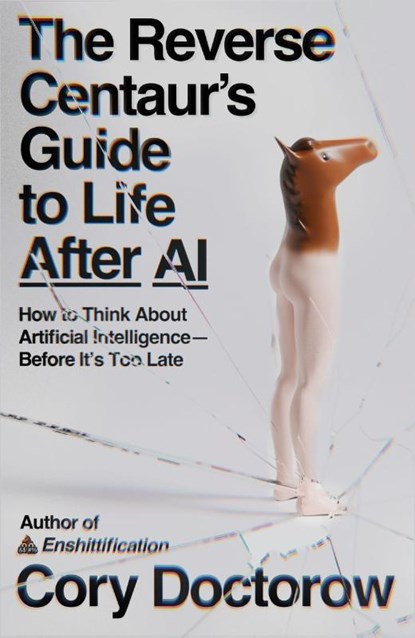
I will be the last to claim that generative AI doesn’t have its uses. I’ve just learned to find those uses in different places. I believe that this type of AI is very useful when we put it to work for humans, rather than putting humans to work for AI. Allow me to explain. In The Reverse Centaur’s Guide to Life After AI, Cory Doctorow explains what role technology plays in our jobs, using centaurs as an analogy. In fiction, the mythical centaur is a powerful horse’s body, with the addition of an intelligent human head (and torso). It speaks to the imagination; we get all the benefits of human intelligence, assisted by the raw power of a horse. In technology, a centaur refers to a human using technology, being assisted by it. You’re a centaur when you use a calculator. You’re a centaur when you ride a bicycle. Using your human intelligence, you can leverage technology to improve the quality of your work or the efficiency of your work, but you remain in charge.
The book, however, describes the inverse: a reverse centaur. This is where technology will do the thinking for you, using humans only when it can’t complete the job. The classic examples are an algorithm deciding for a delivery person where to go, how many packages to drop off, and when to take a break (if allowed). The human is monitored from all sides and is required only to drive and to bring the package to your door. This person works for an AI system.
Ask people what they would like their job to be in a year
Why should it matter to you? Leaders in companies of every size and every sector are asking how to develop agents that can do different things. LinkedIn gurus tell these leaders that agents can do just about anything, and so consultants (like me) are sent out into their businesses to enable this type of application. Typically, that means mapping out some business processes and deciding what could be automated by an agent. This will often lead agents to try to capture the big picture and bug humans to review endless documents instead. Please don’t turn your colleagues into a reverse centaur.
Instead, take your analysis a step further and talk to the people involved in those processes. Ask people what they would like their job to be in a year. It becomes easy to spot where AI could help them automate the monotonous, boring parts of their jobs. The resulting applications aren’t the fanciest uses of AI; they border on the mundane use of a coding agent. But then again, calculators are pretty mundane too, and I wouldn’t want to go without one. I would rather be a centaur.
You might be surprised I’m actually promoting a coding agent in this piece. But as Doctorow also put it in his (almost) daily newsletter, the difference is in discernment: an expert using an AI tool to do their job has a very different experience and output than somebody with little experience being told what to do by AI. The people who will sell you AI claim that it can do your job. It can’t. But you can do parts of your job in a way that you enjoy more, and perhaps AI has a role to play there.
The language of prediction

Again, artificial intelligence, generative or otherwise, has its uses. But also, depending on how you use it, it can be downright harmful. Whether you’re using an image recognition model or an LLM, artificial intelligence today boils down to a machine making predictions. A prediction can be harmless, for instance, if you use machine learning to predict the weather and make a wrong prediction: the weather doesn’t care. Your model doesn’t decide when it rains. The weather remains unaffected by your erroneous prediction. But when your software predicts whether somebody gets a loan or is eligible for a certain education, it can inflict real damage. Just remember the Dutch childcare benefits scandal, where incorrect predictions by government software led to severe consequences for many families. In Prophecy, Carissa Véliz makes this distinction very clear.
The book is part philosophy, part history lesson, and part love letter to literature. It explains the role that prophecies have historically had, and how this translates to AI today. A prediction can be powerful when applied to humans. It’s exceptionally powerful in part because it uses the same language as everyday, normal facts. The key distinction to keep in mind is that the future holds no facts. Facts are created in the present and belong to past events. When a CEO of an AI company says “this is the future”, remember they have a stake in how the future unfolds. They make these predictions, hoping to steer the future in a certain direction. It’s up to you how you deal with that.
According to Véliz, a prediction is an invitation for defiance, so next time you see an AI keynote full of “facts in the future”, consider them inviting you to disagree. If you need a place to start, Véliz and I agree that reading a paper book is an act of defiance, so buy one of them at your favourite bookstore and try to make sense of the world.